Showing posts with label food. Show all posts

harvesting


It must be Harvest time. 
Pickles, relish, pasta sauce and pesto to freeze, apple pie, bottled fruit and herbs drying on the rack.
Produce from our garden, and fruit from friends, our neighbours and the Plenty to Share stall across the road from the local store. 
It's easy to give thanks right now - the table is abundant, the cupboards full and the warm weather is still holding. 


And yet, even in the fullness of the Harvest, there seems to be the onset of decay - the first leaves turning, the bean vines drying, the flowers spent on the compost piles.
The ever-present paradox of this sweet life.
Right now, I'm feeling full of all this goodness and am hoping this gratefulness can hold me through the darkest times of the winter to come because she sure is coming.

garden notebook

The late Autumn settled weather is just what we have needed to catch up on some of the garden tasks before the wet and cold seriously settle in.  Over the Summer months I tend to be in the garden early, early in the morning, before others are up and late into the evening. These are my very best parts of the day - the quiet, the light, the ability to be single focussed. With Winter Solstice just around the next corner the days are short and I tend to steal short snaps during the warmth in the middle of the day. 

Over the last couple of weeks we have been:
> Doing some serious compost turning and building after picking up some more horse manure from a local riding school. The garlic needs to go in, like yesterday, so I have preparing a bed underneath one of the initial compost heaps. 
>Wondering about where to source some more of the garlic I want to plant since last year's crop suffered due to moving house.
> Brewing batches of mint sauce, similar to these recipes here - a favourite that reminds me of my childhood home.


> We had fun cracking open the pumpkins we had grown for harvesting the seeds - Austrian Hulless from the Koanga Institute.  A couple produced good, plump seed, now drying near the fire to roast up and eat in our muesli. Many of the pumpkins were smaller and the seeds weren't fully mature. A great study in seed collecting (and in using an axe!)
> Sky's fungi documentation grows as we continue to find mushrooms working hard on the wood in our garden. This film talks a little about the importance of fungi for our forests and gardens.
> Tidying up the guttering system so that we are more effectively collecting the water that comes off the roof of the house. Adding another barrel to a corner of the house which will water the nearby garden come Summer.
photo by Sky

We all spent this afternoon in the garden - deep contentment. Each with their own task, the girls coming and then going and returning again. They were experimenting with sifting some soil from one of the messy parts of the garden; shaking, swirling and flicking. It was nice to see the sieve used as it usually hangs on the chicken gate. I like looking at it. I love it's shape and simple, sturdy construction but don't fancy the patience one would need to actually use it.

our community garden


It was our day at the community garden today.
We have been going each week since Sky was just 2 - a wee one, never saying much, just trotting around finding things to be quietly fascinated with. Some things don't change much, although she does become chattier without her big sister about.
We lived just two doors up the street then and were down there most days at some point; tending the garden, passing through on our way to the village or meeting with others at the building on site.
Now we are further away and with other interests vying for our time I recently suggested we stop going for a while.
Ruby's jaw literally fell open and Sky exclaimed "What? Not go to the community garden?"
Immediately I was could see this wasn't, in fact, a possibility. 
Which I kind of knew already.
I was relieved.


Because it's not just the environment that we enjoy - being in the weather with the dirt and plants and insects.
Nor the questions and knowledge and new skills we take away, little by little, each week.
Nor the chance to work our bodies in ways that bodies have worked for millenia (ok, to be honest, I've done very little of this for a while now).
Nor all the new people that come through on their way to somewhere else, who we get to meet and chat with and learn from (I think this is Ruby's favourite part).
And not even just the food we get to raise and harvest and eat.

What it really is, is the relationships we have forged over those years.
Relationships that feel more like whanau - aunties and uncles and cousins. 
Relationships and a community that have blessed us with the feeling of belonging and loyalty and commitment and love.
Community I have looked for all my adult life; one that shares in dreaming and rethinking community, family and living with each other on this dear earth in general.
Friendships that stick around, with the garden as the home we return to.

The garden


Having time to grow a lot of our our own fresh food is central to how we organise our life. When the girls are thinking about what they want for dinner we want them to grow up knowing to first check the garden to see what is ready to harvest. Spending time growing food and eating it fresh from our garden is central to how we take care of our family's health - physical, mental, emotional and spiritual.
The food garden takes up most of our 1/4 acre property, now that we have ripped out most of the long driveway. A large part of the success of our food growing is the fact that we have designed it so that we walk through it to get to the front door. Close proximity is my number one tool for managing a large garden as it makes it easy to do either small snatches of work or longer stretches. 
We don't manage it all. I had an almost nil harvest of potatoes this year, I'm still not planting nearly enough carrots and I can't seem to get anywhere with a lot of my beetroot. As well as this I choose to have a garden where the weeds, at manageable levels mostly, are integrated into the overall system. I don't want to do battle in my garden.
I thought I'd write some semi-regular posts on what we've been up to in the garden (and some of what the outcome is in the kitchen) since we spend so much of our lives in it.


Over the last week this is what we have been up to:
> Sowing my last lot of mustard and lupines seeds in empty beds to fix nitrogen in the soil for the next growing season.
>  Pulled out the last of our tomato plants (just in time for the first frost) and hung any still with green tomatoes on upside down in the carport. 
> Made a little more headway with our bug hotel. Of course we have bug habitat all over our property in small piles of branches, under rocks, in the leaves but these bug hotels are so sculptural and pretty. I liked the idea of one being part of the garden especially in the barer months of Winter but to be honest, at this stage I seem to have more enthusiasm for this project than either of the girls.  
> I managed to grow a few peppers this year in a cold frame but not enough for the pizzas we make all year round. I have been buying some while the local ones are cheap, slicing them up and freezing them, ready for pizza topping in the heart of Winter. 


> Plodding away at laying a new path at the back door.
> Enjoying the wealth of kale in the garden and slow-cooking it in a new favourite soup for us.

Soak 1 1/2 cups of split peas overnight. 
Drain and pace in slow-cooker with some stock. 
Saute an onion, grated ginger, coriander and cumin seed. I also have added a couple of leeks as we have a surplus. Grate a potato into the slowcooker and add the sauted ingredients, rinsing the frypan with some fresh water and adding that to the cooker. Slice up and add kale (and/or silverbeet if abundant). Just prior to serving up, blend with a stick blender. Yum.

> Dallying around on deciding which rooster we are going to give away. Three of our fertilised eggs hatched last November and two of them were roosters! The plan was to eat one but although we have had rich conversation around ethics, animal rights and the general consumption of meat, the girls are not ready to kill their food. We thought he was a hen for the first four months. His name was Elizabeth. You can see the dilemma.
>Hauling an armload of weeds from the edges each morning and throwing them to the chickens. They particularly love dock, puha, chickweed and dandelion - all good herbs for their health.
> Assisting the bees this Autumn with a heavy honey syrup and watching appreciatively as they forage on the few flowers left in the garden.
> Appreciating the mundane task of bundling cabbage tree leaves for the Winter fires. As I work with my hands at the repetitive task, my mind frees up, sits quietly and allows reflections and insights to drop gently into the space created. The gift of the mundane.


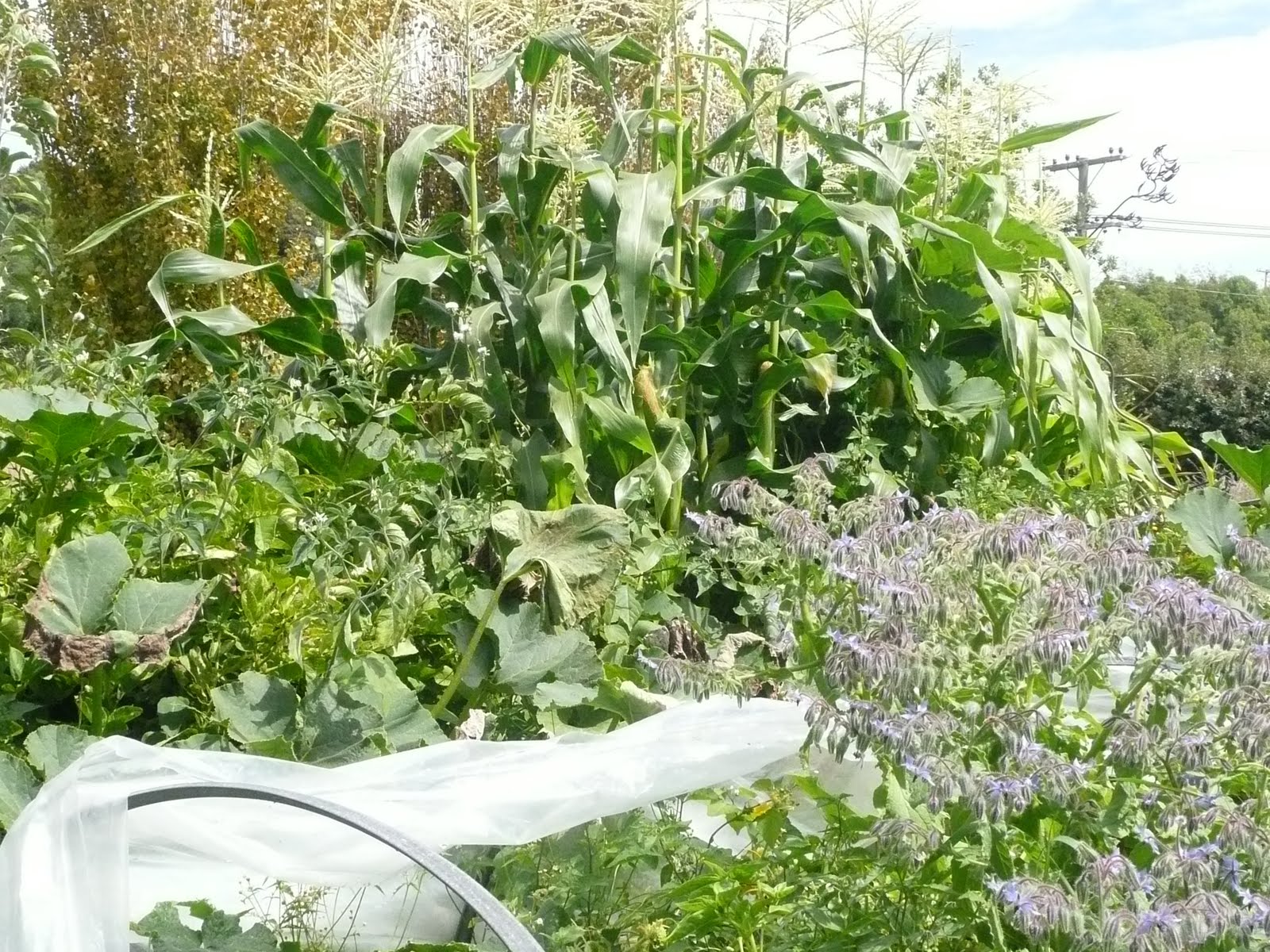
> Finally harvesting our large bed of corn. Moving back here last October meant that my corn went in very late. That and a cool Summer meant that it looked doomed by the end of February but our warm Autumn gave the kernals enough time to plump up. There has been corn stuck in our teeth during most meals this week and tomorrow there is a few batches of relish planned.

Corn Relish
3 cups corn
2 onions, 4 tomatoes, 1 zucchini, 1 green pepper, all chopped finely.
3/4 cup sugar
1 Tbsp salt, 1/2 tsp back pepper, 1/2 tsp timeric, 1 tsp dry mustard, 1 tsp coriander
1 1/2 cup white vinegar
Boil for about 45 minutes.
Place into sterilised jars.

The first frost arrived last week and the shadows are covering a lot of the garden most of the day. The length of the list surprises me but just goes to show what is achieved in small but regular bites of time. 

the bees

We have bees.
This is our first season and we got them fairly late in the season.
We wanted to catch a swarm in the Spring.
When I say that it sounds like we know what we are doing. We don't.
We had read about it and watched a bit of footage. We felt that if we were to keep bees, catching a swarm was the right place to start.
We put notices through our local networks and on local noticeboards.
No calls came except the day before we were leaving on a 3 week holiday in the Summer. We had to say no.
We were about to give up on the idea but then got a call from a friend who was splitting her hive.
She was willing to share her bees.
Bless her.
Gunter built a hive (plans here) for us last Winter.
He's a good man for getting on and building it because a year ago he wasn't at all convinced that keeping bees was a good idea.
It was really showing him this DVD that changed his mind - a step-by-step, how-to DVD on keeping bees in a topbar hive and an introduction to bee guardianship.
He was encouraged by the respectful and gentle approach of the beekeepers.
We liked the concept of natural beekeeping
I too am a total newbie but bees have been on my mind for a few years now. How can they not be? Anyone who works at all with plants have noticed their rapid decline. All I needed was a bit of encouragement and so I organised a weekend workshop at the our community garden.
If you need a taster, make sure to watch this film. If you need convincing watch this film.

Our hive sits right next to the deck in a warm and fairly sheltered spot.
We see them every day.
We still don't know much but we are learning step by step.
Like the first child, the next step unfolds before you and you step into that space.
We watch the hive entrance - it has become our favoured cuppa spot.
It is the place I go when things begin to unravel just on dinner time.
Just for a moment I sit with the bees.
Their gentleness astounds.
I leave calm and quiet.

sticky buns and birch bolettes.


Foraged mushrooms are finally on the menu.
For too long now I have wanted some help with identifying mushrooms but it's information that is hard to come by. Generally for the average Kiwi, if the mushroom doesn't look like a field mushroom you steer clear.
The impetus to move forward came from Gunter coming home after spending a week walking in a forest full of "stick buns:" mushrooms I wouldn't have recognised but he did from his younger years in Germany.
He gave me the confidence I needed to investigate further.
I love starting out on a new learning path when all of a sudden large parts of the world become new again and our scope widens in breadth.
I'm suddenly seeing fungi everywhere.
Sky's drawing up mushroom posters.
Gunter is planning the feast.
We are walking along routes we haven't for a while just to check out he mushroom possibilities.
This morning Gunter and I pulled the girls down the road in their pj's to see some birch boletes I had seen on my early morning walk. The excitement was palpable.
It felt good to know what they were and to name them.
It felt good to know that they are edible.
It felt good to be sharing with my co-learners: holding hands when needing confidence, sharing the excitement of the discoveries, spurring on the enquiry with new questions and fresh directions.

keeping it wild

Science in the kitchen; yogurt, apple cider vinegar and feeding the sourdough starter.
We are just now starting to get really excited by wild fermentation. Our favourite up until now has been sauerkraut (a sure winner for a german partner) and we are starting on a new batch tomorrow using the cabbages I saved from my abandoned garden over the weeknd.
I like the experimental nature of brewing, fermenting and feeding bugs in the kitchen.
It is all a bit check it, smell it and see what you think.
It encourages bravery and courage.
It nurtures an attitude of wonder; I'd say the perfect starting point of any scientist.
And on the uglier side of things....if you live in Aotearoa and want to be enraged, check out the NZ Food Bill 160-2; read about it here, here and here.
To tell you the truth, when I was first told about it I just wouldn't believe it, and I believe lots.
It will affect all people who share seeds and who sell their own produce from the roadside or at our beloved Farmers' Markets. Unite with the world's poor who are also fighting similar laws in their own country, sign the petition, write to your MP and generally make a racket.

introducing: the section on the hill

This is part of the half acre section we bought 3 years ago.
After the earthquake in February and 2 years of trying to sell the section we have decided to refocus on moving on to this section on the hill.
We feel very committed to this town, it seems obvious (now) that we recommit to the place we already have. Lyttelton being "quake central" we are guessing that there will be minimal, if any interest in buying land here for a long time yet and the longer we hold it while living somewhere else the further we go down the financial plug hole.
So here we are again - in some ways in the same place we were 2 years ago but in other ways standing in a different place within ourselves.
The vision for this land has always been to develop a thriving edible landscape; part food forest, part intensive beds, a few animals (chickens, ducks, bees, our worm farm and anything else that would fit) integrated into the design and some type of shelter for the humans!
The steps were dug by Gunter a couple of years back just before we abandoned the idea of building here the first time around.
On the left, off the photo, is a steep gully planted up in native seedlings that are thriving. Thanks to the timebank member who offered us his seedlings growing on his property and advised us to plant small; the smaller the seedling, the better they will take hold.
It seems to have mostly worked.
On the driveway the native species we planted are also growing well. This planted up edge is planned to buffer the property creating a corridor for native birds and other native insects, adding biodiversity and creating a shelter belt.
Most of the rest of the property looks like this.
The section faces almost directly South (for those from the Northern Hemisphere, remember for us in the South this is fairly bad news) and is steep as is most of the land in this small town.
It isn't all bad news though.
Look at the view we savour whenever we are here and with good permaculture design we will do the best we can and the rest we will rely on local systems to provide.
gorse
We also have quite a bit of this thanks to our English pioneering ancestors. In line with looking around at what we have an abundance of and using that, I have had plans to harvest this to experiment with plant dyes but haven't got there yet.
There a few edibles in amongst the grass, in particular chickweed, a staple salad ingredient at the moment, yarrow.....
and a lush and healthy nettle plant that we imported from our last house. I brought it for it's seeds. I'm planning a large plot of healthy nettle. For eating raw, the sting will disappear once you have rinsed it under cool water.
We continue to try to rent out or sell our small bach that we moved out of in March but in the meanwhile we tend this garden aswell; harvesting food and kindling and collecting green waste and compost.
There is a lot we can not do or do not know at this stage but there is much we can do and this is how we have chosen to reconnect with our section on the hill.
There is one terrace on the hill.
This is where we have started; clearing the grass a bit at a time with the machete, laying an easy sheet mulch bed and getting a bed of garlic in the ground.

Thinking as a community.

"There is no personal enlightenment.
Awakening occurs only in the activity of loving relationship."
-source unknown

Self-sufficiency, the term, is bandied around quite a bit these days.
I guess I just don't quite get people's thinking around it.
Don't get me wrong; I am committed to growing as much of our food as possible for our family, preserving the surplus, making as much from scratch as possible or recycling, upcycling or just doing without.
In a nutshell, keeping our home and family as a unit of production rather than of consumption.
But self-sufficiency has never been our goal.


Self-sufficiency surely is an illusion.
We live in a community with others and are part of the awesome web of life on this planet.
There is no me without you; there is no self separate from the whanau of others.
And so when we think about future-proofing the way we live we inevitably think about the community in which we live.

We practice thinking as a community.


(All photos taken while at our local Farmer's Market recently.)

For example, we live in a village which faces in the main southwards.
Not ideal growing conditions here in the Southern Hemishere, so when we look at food production as a community, we think about how we can design the community as a whole on permaculture principles.
We imagine dividing the village into microclimate zones so as to grow suitable crops for the particular climate of each backyard and sharing out the harvest.
When we get excited about becoming kaitiaki for honey bees we think of people in the community sponsoring the care of village beehives for the benefit of everyone.
When we think about the local economy, we think about an economy that will support everyone in the community not just line the pockets of a few. We barter where we can, we support the Timebank and we investigate cooperative ownership of business and land.
And when we think about growing our children, we look to our village and all the wisdom and skills embedded there and we rely on this to be the foundation upon which our children can grow safe and happy
.
So when we were asked why we were returning to Christchurch while at Auckland airport recently (the woman who asked was truly shocked that we would be doing such a thing), the answer for us was obvious.
We feel deeply thankful to have found this community after so many years of searching.
To dig our feet in here and to commit to the place means that we can call it home.


easy meals

Oh I love the ease of menu planning at this time of the year.
Look in the garden and harvest what is ready - the evening meal is half done.
Below was the haul from this afternoon bar the cherry tomatoes which were devoured on picking and the beetroot that were already in the pot.

We have been swamped with cucumbers this year.
We had expected a meager harvest; having no glasshouse I thought it would struggle to be consistently warm enough.
However, being a Summer staple in our family I germinated a few seedlings and stuck them in under a cloche. You can see it at the bottom of the photo below.

Even with loads of competition from the corn, pumpkins and tomatoes, we have been enjoying cucumbers daily from that small strip since December.

I do think there is a lot to be said about just giving it a go in the garden and being ready to be surprised.

I'm guessing the magic has been the regular doses of worm juice.
At last we have an effective way of decanting the worm juice into used milk containers throughout the year, ready to be diluted in the buckets and watered at the plants feet.